Indoor Grow Setup Checklist - Homegrown Nursery
Indoor Grow Setup Checklist
Whether you're growing indoors by choice or because your state requires it, a successful indoor cannabis grow comes down to controlling a handful of variables well: light, air, temperature, humidity, and space. Missing even one of these can undo an otherwise healthy setup. This checklist walks through everything worth having in place before your clone arrives, organized by category so you can build out your space step by step. If you haven't chosen a strain yet, our Strain Comparison Guide can help you match genetics to the space you're planning below.
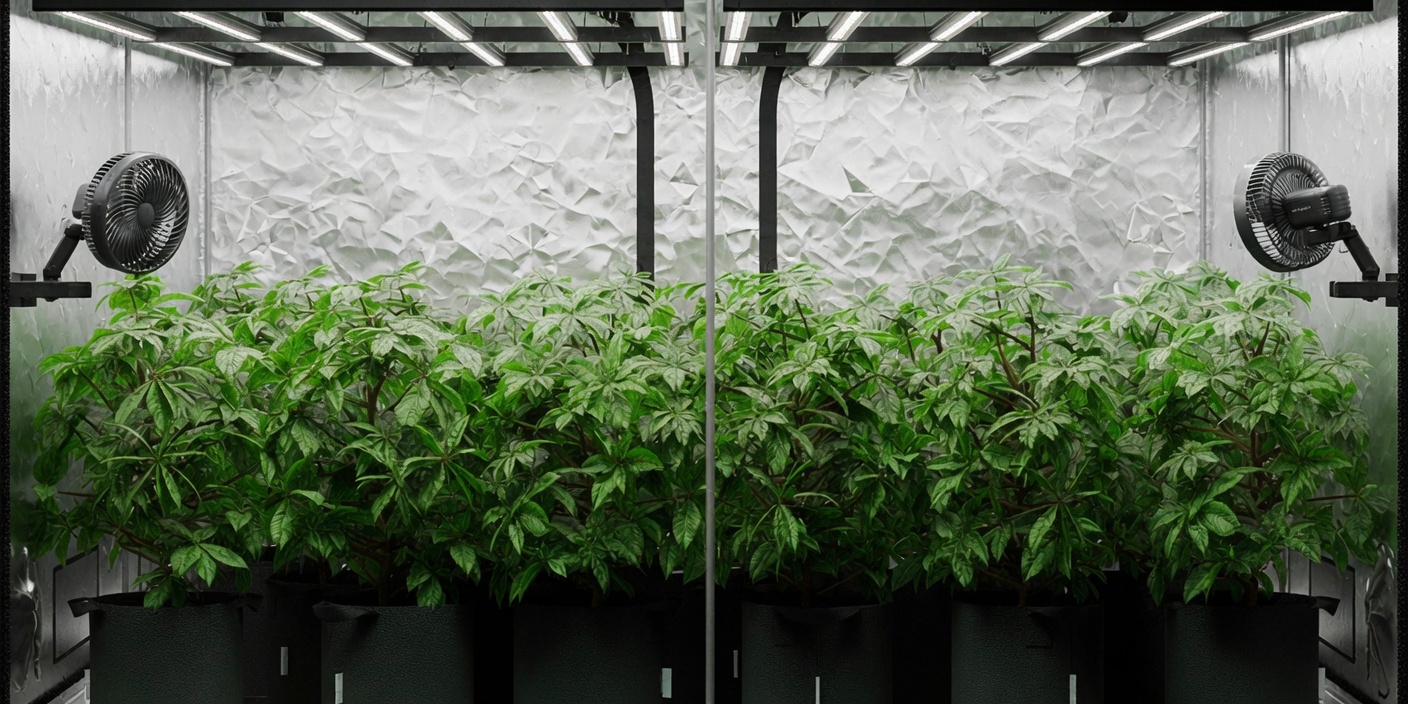
A typical indoor grow tent setup, with the core equipment from this checklist labeled.
Why Set Up Before Your Clone Arrives
A shipped clone is already dealing with transit stress by the time it reaches you. The faster it can go from box to a stable, ready environment, the faster it recovers and starts growing. Scrambling to buy equipment after your clone shows up costs it valuable recovery time — everything below is worth having ready in advance. See our shipping and packaging policy for more on what to expect when your clone arrives and how quickly to act.
Grow Space
Tent or dedicated room. A grow tent is the most common starting point for home growers — reflective interior walls, built-in vents, and a fully enclosed space that contains light, smell, and mess. Common sizes for a single plant or two are 2x2 or 2x4 feet; a 4x4 tent gives more room to grow but costs more to fully equip. Some states legally require cultivation to happen in an enclosed, locked space regardless of tent vs. room — check your state's page for specifics.
Space planning around plant count. Know your legal plant limit before buying a tent — sizing a space for more plants than you're actually allowed to grow wastes money and space. Our state pages break down exact plant-count rules; for example, Colorado and Connecticut require indoor-only cultivation with specific per-person plant caps.
Locking mechanism. Many states require the grow space to be lockable and not accessible to minors, independent of whether cultivation must also happen indoors. A simple door lock or padlock on a tent zipper satisfies this in most cases — confirm with your specific state's requirements.
Lighting
Grow light. LED is the standard recommendation for beginners — lower heat output than older HID/HPS setups, lower electricity cost, and simpler to dial in. Match your light's wattage and coverage area to your tent size; an undersized light is one of the most common reasons a first indoor grow underperforms.
Light timer. A consistent light schedule is critical for a photoperiod plant, especially the sharp switch to 12/12 that triggers flowering. A mechanical or digital outlet timer removes the risk of forgetting to switch the lights manually, which can stress or reverse a plant's flowering progress if the dark period gets interrupted.
Reflective tent lining. Most tents include this built in, but if you're building a dedicated room instead, reflective material (like Mylar) on the walls significantly improves light efficiency by bouncing light back onto the plant instead of losing it to the walls.
Airflow and Climate Control
Ventilation fan. An inline duct fan (often paired with a carbon filter) pulls air out of the tent, drawing fresh air in and keeping temperature and humidity in check. This is different from the small oscillating fan below — most setups eventually need both.
Oscillating fan. Gentle, direct airflow across the plant strengthens stems and helps prevent mold by keeping moisture from settling on leaves and buds — especially important during flowering.
Carbon filter. Pairs with your ventilation fan to scrub odor from the air before it exits the tent. Worth prioritizing in any setup where discretion matters, which is most home grows — see our Strain Comparison Guide for notes on which strains run stronger on smell if odor control is a top concern.
Hygrometer/thermometer. A combined humidity and temperature gauge is essential for monitoring your tent's conditions day to day — most growing problems (mold, heat stress, slow growth) show up as a temperature or humidity swing before they show up on the plant itself.
Dehumidifier or humidifier. Whether you need one or the other (or both, at different growth stages) depends on your local climate and how tightly sealed your space is. Coastal and humid-climate growers usually need active dehumidification during flowering; dry-climate growers may need the opposite during veg.
Heater or AC, if needed. Most indoor setups need some way to manage ambient temperature beyond what the grow light and ventilation alone provide, especially in spaces with poor insulation or extreme outdoor conditions nearby.
Growing Medium and Containers
Containers with drainage holes. Fabric pots are a popular choice for the airflow they provide to root systems. Start small — a 1–3 gallon pot is plenty for a fresh clone, even if the long-term plan is a larger container or bed, since oversized containers hold more moisture than a small root system can use.
Quality soil or growing medium. A light, well-draining mix designed for cannabis (or a soilless medium like coco coir) gives roots room to establish without waterlogging.
pH meter or test strips. Covered in detail in our pH management guide — critical for making sure your plant can actually absorb the nutrients you're feeding it, regardless of medium.
Feeding and Watering
Mild vegetative nutrients. New clones need a light, diluted feed — full-strength nutrients can burn a still-developing root system. Scale up strength as the plant matures into vegetative growth and flowering.
Watering can or reservoir. Simple, but easy to overlook — consistent watering technique matters more than most beginners expect, and a dedicated watering container (rather than whatever's on hand) makes it easier to measure and stay consistent.
Spray bottle. Used to mist new clones and maintain humidity around the plant while its root system is still minimal, especially in the first days after transplant.
Training and Space Management (Optional, But Useful)
Plant ties or clips. Useful for low-stress training (LST), a technique that bends and secures branches to create a flatter, more even canopy — helpful for maximizing yield in a space-limited tent. Our training techniques overview covers LST and SCROG in more depth.
Trellis netting. Used for the "screen of green" (SCROG) technique, where a horizontal screen trains branches to grow through it, spreading the canopy evenly under the light. Particularly useful for taller, sativa-leaning strains grown in a shorter tent.
A Simple Starter Checklist
If you're assembling a first-time setup and want the shortest possible list to get started safely, prioritize these in order: a properly sized tent or enclosed space, an LED grow light with a timer, an inline ventilation fan, a hygrometer/thermometer, containers with drainage, quality soil, and a pH meter. Everything else on this page can be added as you go, but these seven cover the fundamentals a healthy clone needs from day one.
Once your setup is ready, browse our current clone inventory or check out teen plants if you'd rather start with a slightly more established plant.